Such is "Pieta" (1990), one of his latest compositions. The artist is not afraid of the concrete, and even of some measure of the illustrative character of his image, the Biblical essence is perceived through a personification of the Russian woman – an almost typical figure, invoking in one's memory the best works of art on the subject of World War II.
But the dynamics of the piece – achieved through the master's favorite constructional lines of diagonal composition, the material – warm and porous chamotte, which invites the spectator to close contact, the 'intermediate', human-relative dimension – all this renders the work a contemporary coloration, determining its natural character in any closed or open environment.
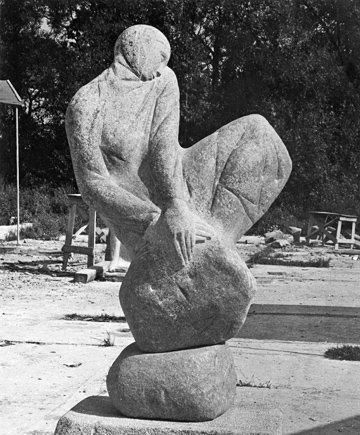
A wide range of realistic feelings and emotions is also a feature for the composition "Memory" – created during the open-air symposium in Yasenki, the work making, in my view, sculptor's greatest success (1988). The fine lines of the silhouette of the sitting woman, the natural wholesomeness of the composition, the music of its rhythms, the soft treatment of the stone, and the combination of incompletely cameral and monumentally and significantly persuasive shows, emotional and plastic unobtrusiveness making the work organic to any space.
1992 |