There have
remained many photographs of the remarkable
Russian philosopher V. S. Solovyov (1853-1900).
Owing to those photographs, we know what he
looked like as a young man, as a mature artist,
and on his deathbed... Here he is posing for
the photographer, and in another picture he
is sitting at a small round table, a glass of
wine or champagne in his left hand, and a rolled-up
newspaper or proofs of an article written by
him – in his right hand... He has been memorized
in his family circle, in a friendly company,
and on the doorsteps at his acquaintances’ country
house next to a life-size rooster made of china...
And now he is lying, with a short hair-cut,
on his deathbed... There have been left also
pencil sketches by a number of draftsmen, and
well-known artists made several painted portraits.
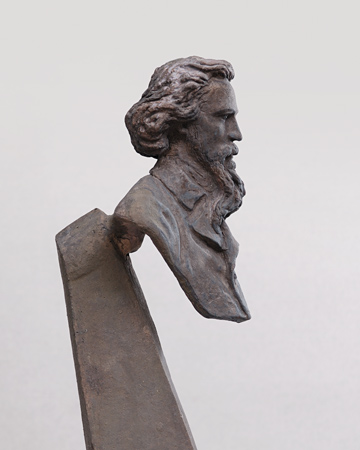
But there have not been made until now any sculptured
image of Solovyov, although sculptor V. A. Yevdokimov
has prepared a model monument.
How can one
render in sculpture the soul, the spirit, and
the body of a greatest Russian thinker whose
creative work has erected to him in the Russian
philosophical science «a monument wrought not
by human hand?” How is it possible to express
it in stone or in metal, to make an imprint
of an out-of-the-ordinary intellect that was
presenting itself in so contradictory a manner
before other people’s eyes – contained in the
philosopher’s live body that was infinitely
more plastic than stone or metal? Which episode
in the short temporal creative evolution should
be preferred to all others. What should be the
means of expression in order to explain best
of all the phenomenon of Solovyov who has continued
to influence considerably Russian culture until
now? Should he be depicted attentively reading
works by outstanding philosophers and theologians?
But this classical writer who amazed his contemporaries
with his erudition, amazes us even more with
the amount of his own works. Should he be sitting
at his desk? But he was not a study thinker!
He did not like to sit at his desk, he wrote
fast, and he sketched the plans for all his
works quite in a casual manner, although he
was not attached to any particular occupation
in life, being a kind of an «itinerant life-watcher».
Soloyov was a traveler in his life-style. Should
he be shown as a pilgrim, walking now in the
suburbs of Cairo, now making his way to literary
gatherings or to slum districts in St. Petersburg?
All these and many other instances of spiritual
manifestations, and of bodily reactions, are
important for understanding the creative work
of Solovyov, all episodes of his life showing
him to us as an outstanding personality, and,
due to the equality of their significance, they
call unquestionably for aesthetic partisan presence
in the process of artistic creation – in an
emulation of hagiographical marginal scenes
relating simultaneously deeds of different times,
performed by the person who pursued the acquisition
of the Holy Ghost. Nevertheless, those may and
should be rejected, although they supply the
most convenient points of support for plastic
arts.
In his model
monument to the Russian philosopher sculptor
Yevdokimov decided to abstract himself – within
the confines to be described by me further in
the text – from the body of the thinker and
from the associated material, earthy world,
to forgo the dynamics of body as much as this
is possible in order to remain within the limits
of plasticity demanding full value of dimensional
expression of a spaceless idea, demanding a
three-dimensional space as a means of creating
at the moment of contemplation an illusion of
atemporal in our everyday life (an illusion
requisite for human mind), owing to which metaphysical
sought through esthetical means provides a vivid
picture of the static of «physical» and fills
with spirit inert flesh (non-living matter)
– an artistic symbol of a once living physical
person symbolizing an entire epoch in the evolution
of spirit, a personality that has moved us closer
to solution of most complicated metaphysical
problems.
Forgoing corporality,
body, physiology, «physics» means reducing a
human body to bust, and sometimes – in certain
contexts – to head. Head as object of esthetic
manipulations does certainly possess the ability
to represent to us the entire human person.
Emphasizing its expressiveness and self-sufficiency
for resolving any esthetic tasks, one can say
that it represents the one essential minimum
of corporality concentrating in it the maximum
of spirituality.
Any other fragment
of human body, a vitally important and esthetically
meaningful minimum of body, receives maximum
spirituality, an importance of an idea, an «ideological
load” -- only in the context of a certain symbol
which is “extraneous” to body and which, while
rendering to it a metaphysiological content
and disclosing its idea and essence, does not
define completely its ontological significance.
Yevdokimov has selected the cross as the tale-telling
context of Soloyov’s writings, which symbol
not only sets out the general cultural context,
but reflects also a certain aspect in the writings
of this Russian thinker who develops the philosophy
of universal oneness. At the same time, the
choice of the cross as the horizonless field
of meanings imposes, this is true, substantial
limitations in sculpturing. It seems to me that
juxtaposition of body to cross dictates unequivocally
elimination of the arms of the depicted person
– even if that person is seeking Christ. For
in this case they «have no place to be in» –
due to the sacral nature of the symbol owing
its appearance to Savior’s suffering at the
cross, they “have no place to be in» in order
not to replicate the too well known posture
of the suffering, in order not to profane it....To
cross them on the chest against the background
of the cross? To stand leaning on the cross-piece?
The cross in the arts is a kind of a «Procrustean
bed» which dismembers the body and cuts off
anything physical for the sake of metaphysical.
It should be noted however that when this sort
of context is chosen, much is lost in the order
of concrete, in expressiveness, because arms,
and hands particularly, are considered as human
person’s «second face.»
Now a few words
about the cross in the composition of our monument.
What catches the eyes is the shortness of both
the cross-piece and the upright piece. The effect
produced is concentration of all vital forces
at the center, the spectator’s attention being
riveted to the point in which the planes intersect
each other, to the meeting point of two spiritual
evolutions, to the place where the thinker’s
body is fastened, a body reduced, esthetically
paradoxical, in accentuation of the living man’s
caricature-like appearance (extreme leanness
and clumsiness). The second, and the most substantive,
distinctive characteristic of Yevdokimov’s cross
consists in the considerable interruption of
the upright piece and its jointing by a massive
rectangular monolith, which may be interpreted
as fortification by philosophical teaching of
previously broken faith, as philosopher’s own
understanding of Christianity, as the corpora
of his writings, whereas the cross-shaped base,
the three-tier foundation of the cross is seen
by me as three stages of historical Christianity,
three main types of its understanding in the
history of humankind – Orthodoxy, Catholicism,
Protestantism. It may also be added with respect
to the last feature that the interruption of
the upright piece of the cross may be understood
also as divergence between the historic Christianity
and the teaching of Christ as such, to which
Solovyov was tending (this is where the bust
of Solovyov is) as he was trying to overcome
the doctrinal limitation of any one religious
confession.
Now let us
concentrate our attention at the bust, at the
spirited face with his bushy hair aflare and
his forking beard. The body of the original
thinker, a typical representative of people
who are «not of this world», seems to be substituted
for with the cross, it is melted into the cross
which in itself, in the exposition of Yevdokimov,
represents a symbol of spirited creative work.
In fact, Solovyov not so much lived in the conventional
sense of the word, as he was engaged in creative
writing. As to his face, it has something in
it of Don Quixote, of St. John the Precurser.
In Solovyov, as well as in the lyrical images
of his characters, there was much of the literary
character of Cervantes, there was much of «don-quixotic»
quality – such as his plea to pardon the terrorists
who killed the tsar, his habitual giving to
the poor, as his possible contribution to redistribution
of wealth, etc. On the other hand, we was, of
course, at the same time a precurser of a new
set of minds, a herald of a new religion (adoration
of Sophia), of a new philosophy (the philosophy
of Universal Unity), of a new science (in the
system of Consolidated Knowledge). Such face
reflects on the whole the personal dualism of
Solovyov, who was a romantic and a reformer,
a fancier and a diviner, a philosopher and a
poet, a spiritist and a publicist, an eternal
bachelor who praised «eternal femininity.»
Those are the
thoughts that were provoked in me as historian
as I looked at the model monument to V. S. Solovyov,
performed by sculptor V. A. Yevdokimov. I hope
that after the collection of the needed amount
of money (a considerable amount!), the monument
made after the model of this particular sculptor,
who has rendered so aptly the spirit and the
soul of one of the greatest Russian thinkers,
shall be erected in the courtyard of the Institute
of Philosophy of the Russian Academy of Sciences.
Vasily Vanchugov
«Magic Mount» journal, No.3, 1995, Moscow.