All the realistic, figurative and abstract compositions, portraits, cameral, genre and monumental works by this sculptor are united by one and the same theme – the study of the life of the Spirit, the quest for it, its birth and acquisition, and which transform man, transform human personality. This unity of the categorical imperative, free of creative contradictions, stands perfectly evident both in the master's work at a classical portrait or a study, and in monumental sculpture which is abstracted from actual realia. The sacral quest of the 'eternal spiritual vitality' of the image, object or theme determines the rendering of the work in shape and in style. Understanding and accepting this position in the art of Yevdokimov explains the emergence of such seemingly stylistically divergent pieces as "MYSTERY" (Sweden) and "Monument to a Nurse of the Second World War" (Khimki, Moscow Region).
Beginning in the 1970's, Yevdokimov created in his indoor sculpture an impressive series of compositions which unite elements of both realistic and non-figurative art – "Ferapontovo", "Steps", "Family", "Cathedral". "Cosmos" and other pieces. These compositions are a quintessence of the sculptor's creative principles, of his understanding of the language of modern sculpture. Their compositional rendering – "space in sculpture" and "sculpture of space" – is based upon shape, rhythm, movement, interaction of the density of the sculpturing material and air, and of natural surroundings. The sculptor never stops to study their interaction, exploiting their introvert and extravert advantages ("Concert of Sviatoslav Richter", "Ascension", "Conversation", "Cosmos" and other works), he seeks some "sacral space" of the plastic composition.
Valery Yevdokimov has virtually no static compositions, all of his works feature the motif of movement, flight, "hovering..." It is evident that in his art that these sculpturing, spatial and emotional kinetics are the absolute dominant feature, his tuning-fork. It is this motif of the spiral that becomes, directly or otherwise, the foundation of the compositional architectonics in his indoor, monumental and drawing works. The physical and virtual dynamics of this geometric model creates spatial and dramatic tension in the composition. In the "INFINITY" monumental composition, movement, progressing along a spiral, becomes the subject and, at the same time, the architecture of the piece. This sculpture rendition is found also in certain portraits and drawings.
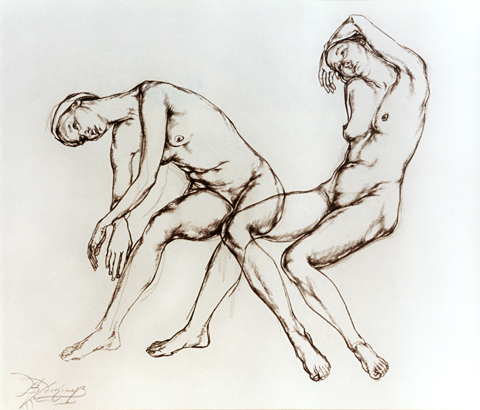
The artist travels infinitely from the two-dimensional space of drawing into three-dimensional space of sculpture. The artist's earlier works are fully academic. In the works of the latter decades we see the same kinetics that are a property of his sculpture. Valery Yevdokimov has introduced into the genre of the classical art of drawing the principle of multiplication – by fixating the physical and actual kinetics of the sitter within the confines of the drawing sheet. It is captured movement, rather than depiction of the sitter, that becomes the intent of the work.
2008 |